.gif)
.gif)

We live in a constant stream of information. Especially since the onset of AI, content is more accessible than ever. This has consequently made visual communications—reports, articles, dashboards, and presentations—more saturated, forcing information to compete for attention. The challenge is no longer access to information, but rather making it meaningful.
Simplifying information is often misunderstood as dumbing things down, but effective simplification is not about removing intelligence or nuance. It is about making ideas easier to process, easier to remember, and easier to act on. The best communicators know that clarity is not accidental, but a deliberate design decision.
Whether you are building a presentation, writing a report, or explaining a strategy to stakeholders, the ability to simplify complex information has become one of the most valuable communication skills in modern work.
Simplification is a design decision
Clarity rarely happens on its own. Every clear presentation, document, or explanation reflects a series of intentional choices about what deserves attention and what does not. One of the biggest misconceptions about simplifying information is that it only happens retroactively during editing. In reality, simplification begins much earlier. It starts with deciding what matters most to the audience. What is essential versus what is distracting.
That distinction matters because simplification and oversimplification are not the same thing. Simplification preserves meaning while reducing friction. Oversimplification removes context, nuance, or accuracy until the message becomes misleading.
Ultimately the goal is not to say less for the sake of brevity. The goal is to help people understand more with less effort, and actually retain what they are consuming. And with shrinking attention spans on the rise (thanks to short-form video content like TikTok), finding the right balance between simplicity and clarity is crucial.
Start with the core message
Before simplifying anything, define the single idea your audience should remember. Many presentations and reports become confusing because they try to communicate too many ideas at once. When every detail feels equally important, nothing stands out and the plot gets lost in the noise.
Clear communication strategies begin with prioritization. When you sit down to start your presentation, you should ask yourself: if someone remembers only one thing after reading this, what should it be?
Once that core message is established, everything else should simply support it. Data, examples, and context still matter. However, they should reinforce the primary idea rather than compete with it. When simplifying information, the core message acts as a filter. If a detail does not strengthen the audience’s understanding of that key takeaway, it may not belong.
Structure before shortening
Many people try to simplify slides by cutting words immediately, but a better approach is to organize ideas first. Information becomes easier to understand when it follows a clear structure. Readers and audiences process content more effectively when ideas are grouped logically and presented in the right sequence.
This is where information design principles become essential.
Start by clustering related concepts together. Then establish hierarchy by showing which ideas are primary and which are secondary. Finally, arrange information in a sequence that feels intuitive to the audience. For example, a sales presentation becomes easier to follow when customer problems appear before product features.
Structure reduces cognitive effort because audiences no longer need to organize information themselves. This is also why headings, spacing, and layout matter so much. Visual hierarchy signals importance before someone reads a single sentence.
Simplification is not only about language. It is also about navigation.
Use visuals to reduce cognitive load
Some ideas are easier to understand visually than verbally.
A well designed diagram can communicate relationships faster than several paragraphs of text. A chart can reveal patterns instantly that would otherwise require lengthy explanation. A picture is worth a thousand words. Effective visuals reduce cognitive load because they help audiences process information more efficiently. They also have a much higher retention rate, which is important if you’re expecting your audience to take action after the presentation.
Dense text forces people to work harder to identify patterns, priorities, and meaning. Visual communication creates shortcuts for understanding, keeping audiences engaged.
Many presentations become harder to understand because visuals compete with the message instead of supporting it. Excessive animations, crowded layouts, and unnecessary graphics often increase confusion rather than reduce it. As a rule of thumb, the best visuals simplify complexity.
Remove noise, not substance
One of the hardest parts of simplifying information is knowing what to cut. Removing noise means eliminating repetition, filler language, and distractions that do not improve understanding. It does not mean removing meaning itself.
This distinction is critical because vague summaries often create the illusion of simplicity while making communication less useful. Specific language creates clarity because it gives audiences something concrete to understand. The same principle applies to editing. Instead of shortening content aggressively, focus on preserving the strongest ideas while removing anything repetitive or unnecessary.
This approach helps simplify without losing meaning.
A useful test is to examine whether each sentence contributes something new. If multiple sentences communicate the same point, combine them. If a detail isn’t adding value to the slide, remove it.
Clear communication is rarely about saying the fewest words possible. It is about making every word count.
Test for understanding, not brevity
Simplicity is not measured by how short something becomes. It is measured by whether people understand it or not.
One of the best ways to evaluate clarity is to ask whether someone else can explain the idea back to you accurately. If they struggle to summarize the message, the issue is likely not intelligence or attention span. The communication itself may need improvement.
This is especially relevant in presentations, where presenters often mistake familiarity for clarity. What feels obvious to the creator may still feel confusing to the audience. Testing for comprehension helps reveal gaps in structure, wording, or emphasis.
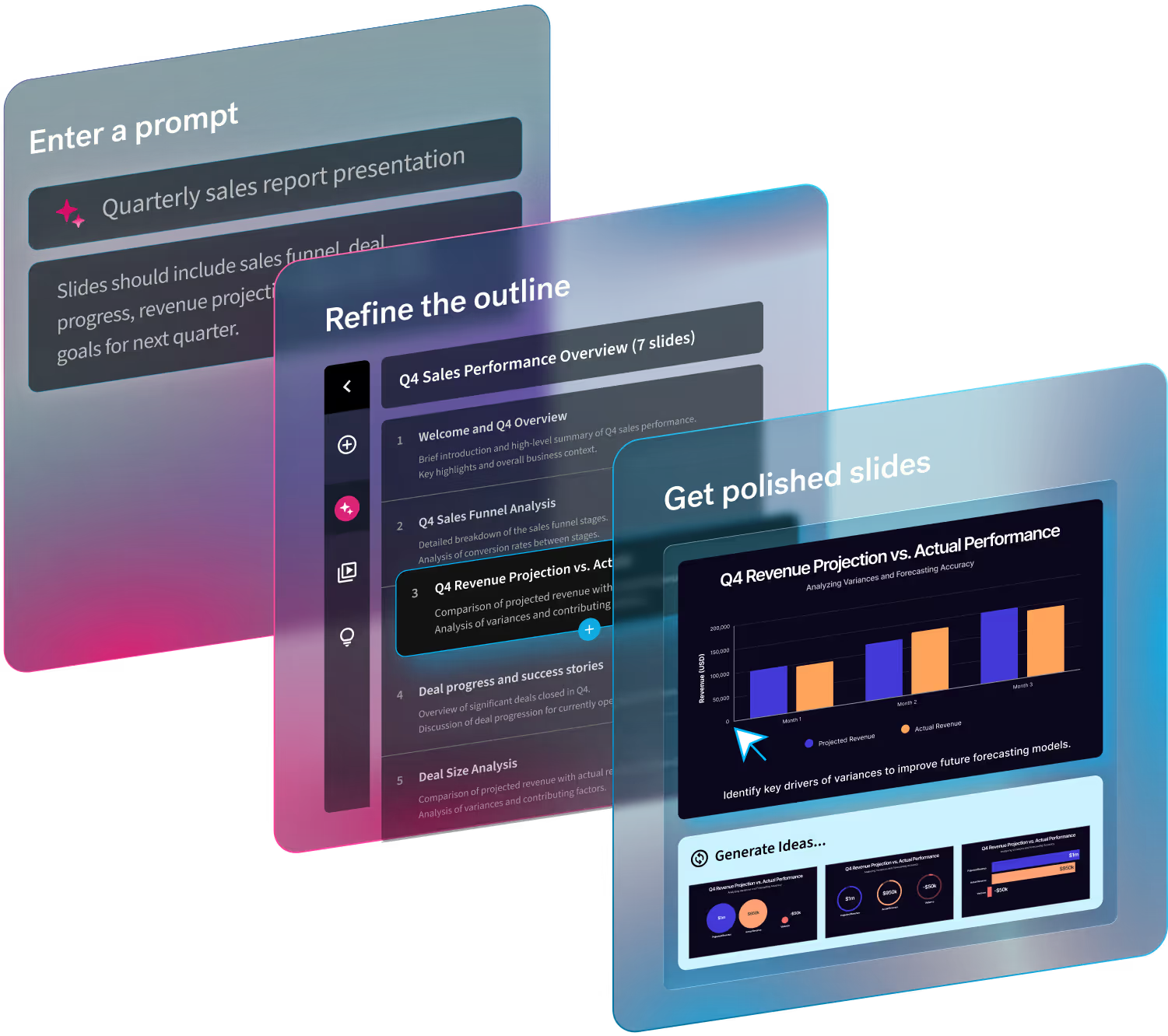
Modern AI tools can help improve clarity at scale. AI presentation makers like Beautiful.ai can prioritize content outlines in the ideation phase, identify dense language, suggest clearer phrasing, recommend visualizations for complex data, and reinforce visual hierarchy across decks. These tools are most effective when used to support human judgment, rather than replace it.
Technology can accelerate simplification, but intentional communication still matters most. The strongest communicators are not the ones who include the most information. They are the ones who make important ideas easiest to understand.



.avif)