



AI adoption isn’t the problem—chaos is
AI adoption rarely fails because the technology is too advanced. More often, it fails because the rollout is too loose.
A team gets access to a few AI tools and people start experimenting. One person uses AI to summarize meetings, another to draft client emails, someone else uploads sensitive project context into an unapproved tool, and suddenly “increased productivity” looks more like scattered workflows and inconsistent outputs. Not to mention, a whole lot of unanswered questions.
But that doesn’t mean AI is the problem. The problem is more likely a lack of structure.
According to our 3rd annual survey of AI in the workplace, 40% of managers said their main reason for adoption is to streamline work and improve efficiency, while 37% said it is to enhance worker productivity. Only 9% said the primary goal is downsizing. That data paints a clear picture: AI is becoming a permanent fixture in many workplaces.
Nonetheless, AI works best when teams are trained intentionally and not left to figure it out one prompt at a time. Intentional rollouts aligned with real use cases and business goals might be the key to successfully leveraging AI in your business.
Start with clear use cases (not tools)
“Let’s use ChatGPT” is not a strategy.
When teams start with a tool instead of a need, AI can become open-ended in the worst way. Everyone is approaching AI with varying levels of literacy and comfort. Employees may not know what to ask, how to evaluate the output, or when the tool is actually helping. The result is usually more experimentation than impact.
A better starting point is to identify two or three high-impact, low-risk tasks where AI can make work easier without introducing major risk. That might include summarizing meeting notes, drafting internal emails, turning long documents into outlines, or creating first drafts of recurring reports. The chance to use AI for company needs in a structured environment can be a critical segue in moving from testing to adoption.
But don’t forget, the ultimate goal is not to use AI everywhere or as a replacement. It is to use AI where it removes friction or unlocks new ways to achieve goals.
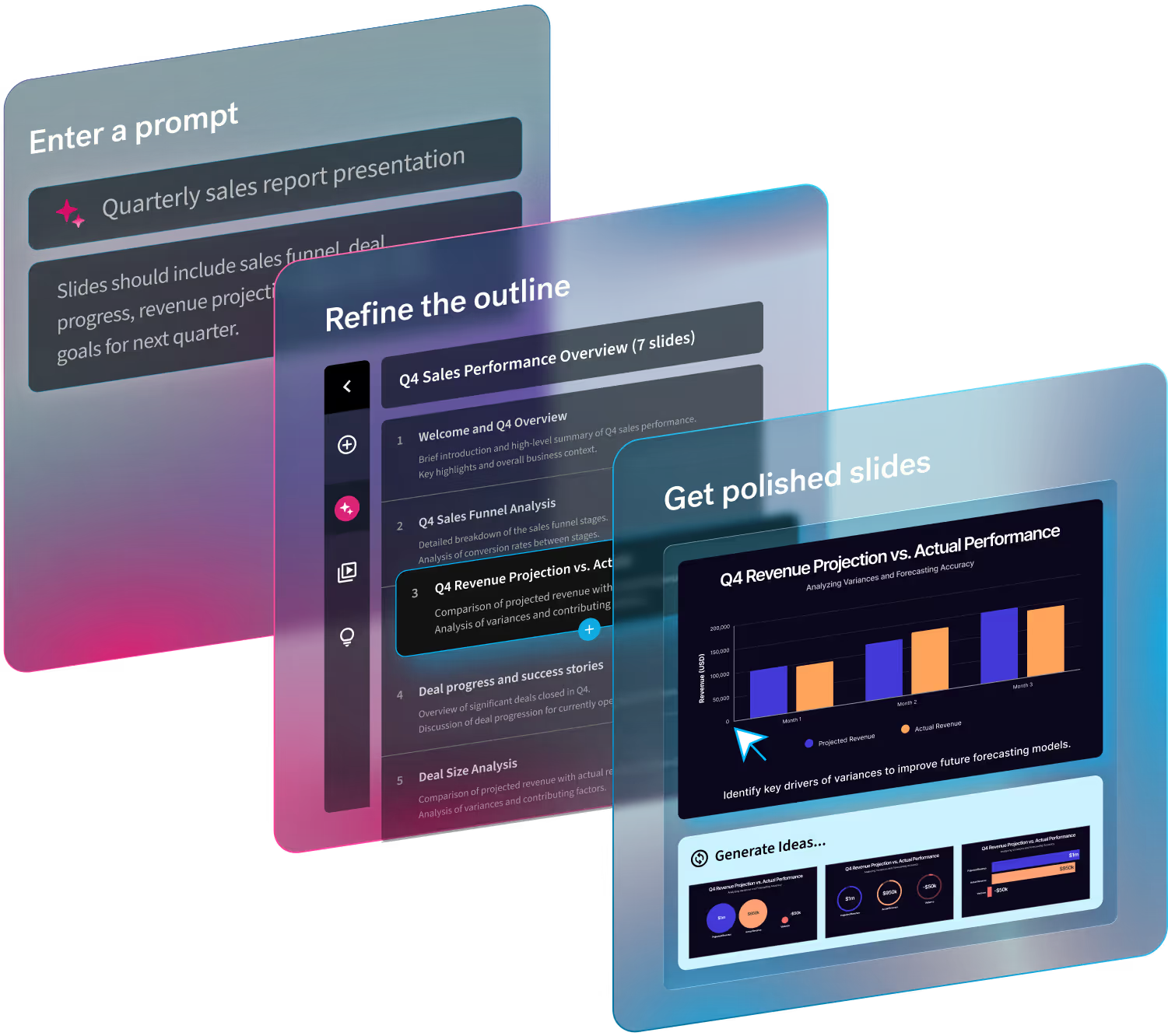
If your team builds a lot of presentations and finds themselves wasting precious time on formatting, AI can help turn rough notes, documents, or outlines into a structured first draft. In Beautiful.ai, prompts or fully fleshed-out outlines can be transformed into brand-consistent, easy to refine decks. That is a practical use case, not AI for the sake of AI.
Set ground rules early
AI needs boundaries. Without them, teams are left to make individual judgment calls about data, quality, privacy, and review standards. That is where avoidable mistakes happen.
Before encouraging broad AI use, define how AI can and cannot be used. Be specific. What company data is off limits? Which tools are approved? When is human review required? What quality standards need to be met before AI-assisted work is shared?
A useful rule of thumb: don’t put anything into an AI tool that you wouldn’t be comfortable typing into a public search bar in front of your boss.
This is especially important because adoption is already moving faster than governance. In our 2026 report on AI in the workplace, 53% of managers said they only use AI tools officially approved by their employer, while 42% said they are open to using tools regardless of formal regulations.
That gap is exactly why managers need to act early. Clear rules do not slow teams down. They reduce anxiety, prevent misuse, and make it easier for employees to experiment safely.
Train by role, not one-size-fits-all
AI training should not be one-size-fits-all. If every team gets the same overview, people may understand the tool in theory but still struggle to apply it to their actual work. That is when AI usage becomes inconsistent: some employees find practical ways to use it, others ignore it entirely, and some use it in ways that create way more cleanup than value.
Different roles need different AI workflows. A marketing team might use AI for content drafting, campaign ideation, message testing, or turning a rough brief into a first draft. A sales team may get more value from email personalization, call summaries, account research, or follow-up notes. A support team might use AI to draft response templates, categorize tickets, or summarize recurring customer issues.
Either way, the point is not to train everyone on every AI tool. It is to show each team where AI can realistically improve the work they already do.
This is where personalization matters. Nobody wants to be told to use a tool that does not help them. It just feels like another task. You would not ask a non-engineer to use Codex or Claude Code if writing and reviewing code is not part of their job. The same principle applies across the organization: AI training should match the team’s responsibilities, comfort level, and risk profile.
Role-specific training makes adoption feel more relevant and less forced. When employees can see how AI reduces repetitive work, speeds up a familiar process, or improves a recurring deliverable, they are more likely to use it correctly. More importantly, they are more likely to trust it as a practical assistant and not a vague company mandate.
Build repeatable workflows
The easiest way to create AI chaos is to make every task a blank page.
Instead, turn AI usage into a repeatable process. A simple workflow might look like this:
Draft with AI → Edit and refine → Fact-check and review → Approve → Publish or send.
That structure keeps humans in control while still letting AI speed up the early stages of work. It also gives teams a shared process they can improve over time.
Templates and prompts can help here. So can reusable knowledge bases, brand guidelines, approved examples, and documented workflows. When using AI for presentations, you might create a standard prompt for turning meeting notes into an executive update. Pair it with a Beautiful.ai Brand Kit or apply your brand standards so every deck follows the same visual system.
The point is not to automate the entire process. It is to make the process easier to repeat.
Appoint AI champions
Managers do not need to be the sole source of AI knowledge.
Honestly, they probably should not be. Identify a few early adopters who are already comfortable experimenting with AI and ask them to support the rollout. Their role does not need to be formal or overly demanding. They can test tools, share what works, answer basic questions, and help teammates troubleshoot.
This creates momentum without turning leadership into a bottleneck.
AI champions also help normalize learning. When employees see peers experimenting, making mistakes, and improving their workflows, AI starts to feel less like a top-down mandate and more like a skill the team is building together.
Normalize iteration and mistakes
AI outputs will be wrong sometimes. They may sound confident while missing context, misinterpreting instructions, or inventing details. Teams need to know that this is expected.
Teach users that the mistake is not getting an imperfect AI output. The mistake is treating that output as finished work.
Managers should make human oversight, to at least some degree, non-negotiable. AI can assist with drafting, summarizing, formatting, and ideation, but people remain responsible for accuracy, judgment, and final decisions.
This matters culturally, too. Employees should not be penalized for being new to AI. They should be given safe ways to learn, test, and ask questions. If people feel pressured to adopt AI quickly without proper training, they are more likely to make risky decisions or avoid the tools altogether.
That concern is already present in the workplace. Beautiful.ai’s report found that 72% of managers believe employees fear AI will make them less valuable at work, and 70% believe employees fear AI will eventually lead to job loss. A thoughtful rollout has to address that directly. Help your teams adopt AI in a way that is meaningful and useful to them. AI tools won't succeed without well-informed humans to use them.
Measure what actually matters
AI adoption should not be measured by how many prompts people write or how many tools the company buys. Those are vanity metrics.
Measure outcomes instead. Are teams saving time? Is output quality improving? Are employees adopting the workflow consistently? Are fewer hours being spent on repetitive work? Are managers getting better drafts, cleaner reports, or more polished presentations faster?
Feedback loops matter here. Ask employees what is working, what feels risky, and where AI is creating more work instead of less. Use that feedback to refine training, adjust tool access, and improve documentation.
AI adoption is not a one-time rollout. It is an operating practice.
Avoid the biggest pitfalls
These big AI mistakes usually come from moving too fast without enough structure:
Over-automation
AI should not take over work that requires human judgment, subject matter expertise, or sensitive decision-making. A model can draft a performance review summary, but a manager needs to evaluate whether the tone, context, and conclusions are fair.
Tool overload
More platforms do not always mean more productivity. Sometimes one or two well-integrated tools are better than a crowded tech stack. Beautiful.ai can help teams keep brand assets, design rules, slide creation, and AI-assisted drafting in one place. Who wants to switch between multiple tabs when they can get a project done in just one?
Lack of documentation
Teams should know who is using which tools, what data is being entered, and where AI-generated content is appearing. Not doing so opens up both individuals users and the company at large to risk.
Ignoring employee concerns or resistance
Perhaps most importantly, managers cannot ignore issues raised by employees. If a subject matter expert says an AI output is inaccurate, trust the human. If the team is uncomfortable with a tool, investigate why. Resistance often points to a real issue in training, process, or communication. This doesn’t mean AI is the problem; it just means that a particular tool isn’t the best fit.
Structure turns AI into a multiplier
AI can make teams faster, but speed alone is not the goal. A chaotic team with AI is still a chaotic team, just moving faster.
The teams that benefit most from AI will be the ones that treat adoption as a system. They will define use cases before buying tools. They will set rules before problems surface. They will train by role, document workflows, keep humans in the loop, and measure business impact instead of activity.
Start small. Pick practical use cases. Build trust. Then scale what works. For teams that create presentations regularly, Beautiful.ai is a practical place to start. It gives employees AI support inside a structured workflow, while Smart Slides, Brand Kits, and brand controls help keep outputs consistent across roles and departments.
The teams that win with AI will not be the fastest adopters. They will be the most disciplined.
Ready to bring more structure to your team’s AI workflow? Try Beautiful.ai today.

.avif)

.gif)


.gif)
